
Protein and Satiety
What a Day of Protein Intake Actually Looks Like
Eleanor Whitfield·
·
11 min read
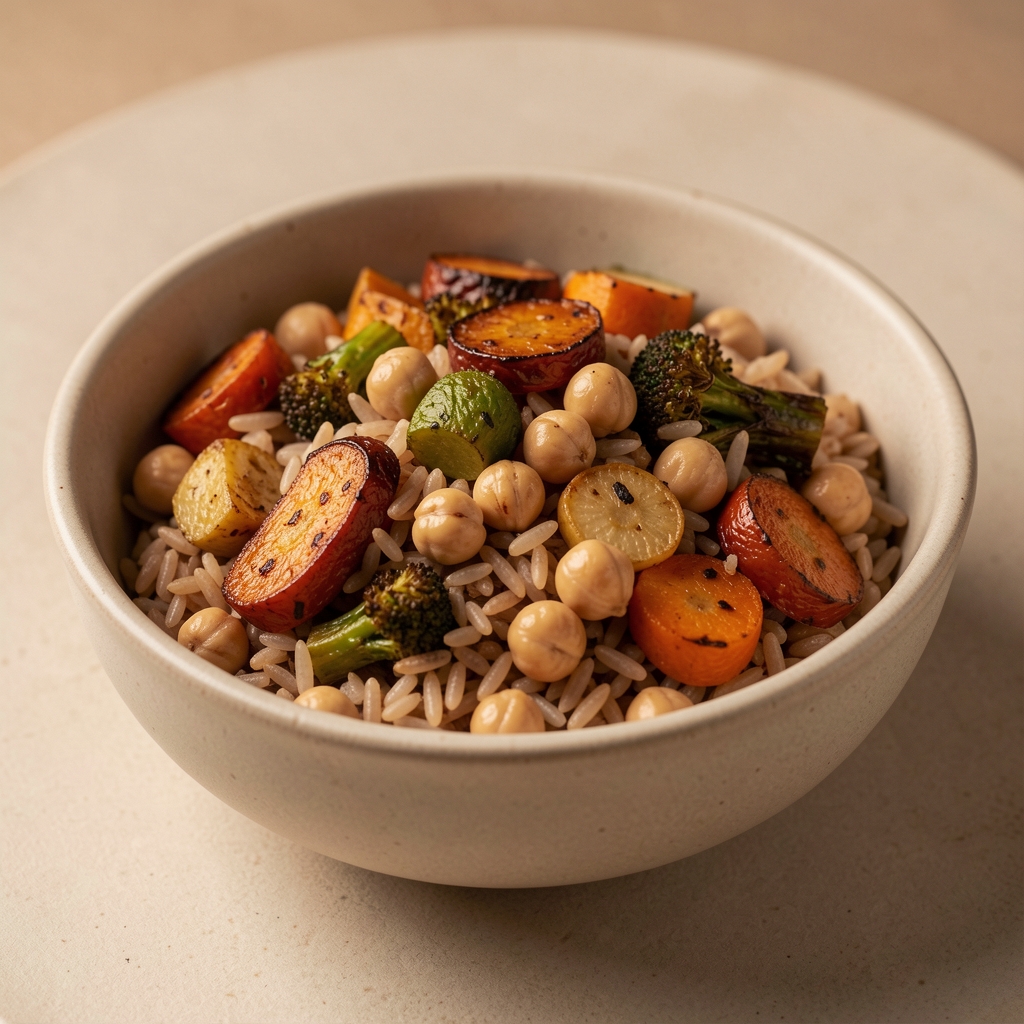
London, February 2026 — The breakfast bowl has become a shorthand for nutritional intention. Oats, grains, fruit, seeds — assembled with care and consumed before the working day begins. What is less often examined is what happens to the energy those grains provide over the hours that follow, and how the distinction between whole and refined carbohydrates connects, in practical terms, to the question of weight maintenance across an ordinary week.
Carbohydrates have occupied an uneasy position in the popular account of eating patterns and weight. For some years, they were cast as the principal problem — the nutrient to be rationed, reduced, or replaced. More recent nutritional research positions them differently: as the body's primary energy substrate, whose net effect on weight depends far more on composition and eating patterns than on total quantity alone.
The carbohydrate role in weight management is, in other words, not simple. A bowl of steel-cut oats and a bowl of cornflakes may present similar calorie figures but very different structural profiles. The oats arrive with intact fibre matrix, slower glucose release, and a more sustained satiety signal. The cornflakes, their grain architecture disrupted by processing, offer rapid energy that dissipates relatively quickly — and with it, the appetite signal arrives again sooner.
This is not a novel observation. What is interesting is how rarely it makes it into the daily calorie awareness framework that most people operate within. Calorie counts are visible, standardised, and comprehensible. The structural quality of a carbohydrate is not — it requires a different kind of attention, one that the food and weight connection literature has consistently struggled to communicate in accessible terms.
"The structural quality of a carbohydrate is not visible in a calorie figure. It requires a different kind of attention."
Eleanor Whitfield — Zumel Quarterly, Feb 2026
The whole grain benefits documented in published nutritional research are now well established in professional contexts, if not always in public-facing ones. Whole grains retain the bran, germ, and endosperm of the original cereal — a structural completeness that carries consequences for digestive rate, micronutrient density, and satiety response.
Studies published in peer-reviewed nutritional journals over the past decade have repeatedly observed that populations whose eating patterns include consistent whole grain consumption tend to report lower body weight variance across multi-year follow-up periods, compared with matched populations whose carbohydrate intake skews toward refined alternatives. The relationship is not absolute — it is mediated by total intake, overall food quality over quantity, and patterns of physical activity — but it is directionally consistent.
The mechanism is not mysterious. Whole grain benefits operate through several overlapping pathways: slowed gastric emptying due to viscous fibre content, lower glycaemic response, greater chewing duration (which correlates with earlier satiety signalling), and higher micronutrient density per calorie. In the context of calorie awareness, whole grains represent a more efficient purchase: the same energy yield arrives with more nutritional material attached.
The breakfast bowl matters not only for what it contains but for what it predicts. There is a documented relationship between meal structure and weight — specifically, the observation that the first meal of the day functions as an anchor point for subsequent eating patterns. A breakfast that delivers sustained energy and adequate protein tends to compress the window in which hunger re-emerges, reducing the likelihood of unplanned snacking before the midday meal.
This is not a trivial effect in the context of long-term eating rhythm. The aggregate of those midmorning choices — whether a second coffee, a biscuit, an unplanned piece of fruit, or nothing — constitutes a meaningful calorie differential over a working week. A breakfast built on whole grain benefits and adequate protein and satiety support can, through this mechanism, shape the entire day's intake without any further active effort.
The documentary evidence here comes from observational nutrition research that tracked self-reported intake alongside weight measurements in free-living adults over twelve-month periods. The consistent finding was that individuals who reported regular structured morning meals — particularly those centred on whole food choices — showed greater weight stability than those whose morning meal was inconsistent, absent, or composed primarily of refined or processed options.
Processed food awareness in the grain category requires some precision. Not all processing diminishes whole grain benefits equally. Rolled oats — mechanically flattened but structurally largely intact — retain most of the fibre matrix that makes oat consumption beneficial in the context of sugar and weight management. Instant oat sachets, by contrast, have been partially cooked and dried in ways that accelerate their digestive timeline and often carry significant added sugar loads.
The sugar and weight management dimension of breakfast cereals is its own subject. Ready-to-eat cereals marketed on nutritional credentials frequently carry added sugar concentrations that override the benefit of any whole grain content present. Reading the ingredient list rather than the front-of-pack claim is the operative act of processed food awareness at the breakfast stage — a simple discipline with measurable implications for long-term eating rhythm and energy balance explained across the week.
For the practitioner of mindful portion habits, the grain decision at breakfast is worth considerable attention. It is not the most glamorous corner of food quality over quantity thinking — whole grains are familiar, inexpensive, and largely unglamorous as a nutritional subject. But the evidence for their consistent benefit to eating patterns and weight maintenance is among the more robust in the published nutritional literature, and the practical change required to access those benefits is modest: swap the cereal, keep the bowl.
The energy balance explained framework — calories in versus calories out — is accurate at a mechanical level but inadequate as a practical guide to eating patterns and weight. The reason is that it regards all calories as interchangeable units, when the evidence consistently shows they are not. The body's response to a calorie derived from oat fibre differs from its response to a calorie derived from refined starch, in terms of digestive rate, insulin response, and satiety signal duration.
Grain quality, within the energy balance explained framework, is a quality multiplier. It does not change the arithmetic of total intake — a 400-calorie breakfast is a 400-calorie breakfast — but it changes the downstream consequences of that intake for hunger, energy stability, and the likelihood of additional intake before the next planned meal. Over weeks and months, those downstream differences accumulate into the kind of weight trajectory differences observed in longitudinal eating pattern research.
Zumel Quarterly's editorial position on calorie awareness is that it is a necessary component of food and weight connection literacy — but that it functions best as a floor, not a ceiling. Knowing the calorie figure of a breakfast bowl is useful. Understanding what that bowl's grain composition means for the subsequent four hours of metabolic response is the layer of nutritional understanding that the calorie figure alone does not provide.
Articles published on Zumel Quarterly are editorial in nature and reflect the writers' observations on everyday wellness practices. The content is not intended as professional advice, nor as guidance for the management of any specific condition. Readers with specific concerns about their daily routines are encouraged to speak with a qualified wellness professional.

Eleanor Whitfield has written about food systems, eating patterns, and nutritional research for Zumel Quarterly since its founding volume. Her work draws on published research across public health nutrition and food science, approached from a documentary rather than prescriptive editorial position.
More from this author →